Picture someone who takes a DNA test expecting little more than a tidy ethnicity breakdown and maybe a few distant cousins to add to a family tree. Instead, the results show a close genetic match with a name they don’t recognize, someone the math says should be a parent or sibling, but isn’t anyone in their known family. This scenario plays out often enough in genealogy circles that it has its own shorthand: an NPE, short for “not parent expected.”
These discoveries are disorienting on their own. What often gets less attention is a second layer to the same moment: an unknown biological parent or sibling doesn’t just rewrite a family tree, it can also introduce an entirely new set of inherited health information that the person never had reason to ask about before. Half of someone’s genetic history, quite literally, can shift in the span of reading one email notification. Understanding how this happens, and how to think through the health side of it calmly, makes an already difficult moment somewhat easier to navigate.
How Unknown Parentage Discoveries Happen Through DNA Testing
Consumer DNA tests estimate relatedness based on how much DNA two people share. Close relatives, like parents, children, and full siblings, share a very high and distinctive percentage of DNA, one that’s hard to explain any other way. When a test surfaces a match at that level with someone unexpected, it usually means one of a few things: a previously unknown biological parent, a half-sibling from a parent’s earlier or separate relationship, or, less commonly, a mix-up in historical adoption or fertility records.
These situations have become far more visible since consumer DNA testing scaled into the tens of millions of users. Databases are now large enough that even a distant relative’s test can eventually surface a much closer, unexpected connection. This isn’t a flaw in the testing, it’s simply a reflection of how much genetic information these databases now contain.
The Double Discovery: New Relatives and New Health Information at Once
What makes NPE (Not Parent Expected) discoveries genetically distinct from most family history surprises is that they don’t just add a name to a tree, they add an entire branch of previously unknown genetic history. Health conditions that run in families, from cardiovascular patterns to certain inherited conditions, are typically tracked through known relatives. When a biological parent or sibling turns out to be someone new, any family health history associated with that side is, by definition, information the person never had access to before.
This can go in either direction. Sometimes it means learning about a condition that runs in a newly discovered family line, information that can genuinely be useful for screening and prevention. Other times, it simply means an absence of information, since a new biological connection doesn’t come with a full medical history attached, only with genetic data and whatever family stories are eventually shared, if any are shared at all.
Why the Health Side of These Discoveries Deserves Extra Care
It’s worth being cautious about drawing firm conclusions from a newly discovered genetic connection alone. Sharing DNA with a new biological relative confirms a genetic relationship, but it doesn’t automatically confirm that a specific health condition will be inherited or expressed. Many health-related traits are influenced by multiple genes and by environment, not by ancestry from one branch of a family alone. A newly discovered relative’s health history is useful context, but it functions as one data point among several, not a certainty.
This is also a moment where it helps to separate well-established genetic findings, like certain single-gene conditions, from broader, less certain associations. A new biological relative with a clearly documented inherited condition is different from a new relative who simply mentions a general health tendency in the family. The first is worth raising with a physician. The second is useful background, but shouldn’t be treated as a diagnosis by association.
Practical Steps After an Unexpected Parentage Discovery
People who go through this kind of discovery often find it helpful to slow down rather than act on every piece of new information immediately. A few steps tend to help:
- Give the emotional side of the discovery time before making decisions, since processing a family surprise and evaluating health information are two different tasks that don’t need to happen simultaneously.
- Ask any newly discovered relatives about documented family health history, if and when contact feels appropriate, rather than assuming shared genetics alone tells the full story.
- Bring any new information to a physician as background for future screening conversations, rather than treating it as an immediate medical event.
- Consider connecting with support communities built specifically around NPE experiences, since many people have navigated the same combination of emotional and informational shock.
When to Involve a Genetic Counselor or Therapist
Genetic counselors are trained specifically to help interpret how new family health information fits into an overall risk picture, and many have experience working with people who’ve had unexpected parentage discoveries specifically. A therapist or counselor experienced with identity and family-of-origin issues can be equally valuable for the emotional side of the experience, which is often significant even when the health information itself turns out to be minor. These two forms of support address different needs, and using both isn’t excessive, it’s often exactly what the situation calls for.
Where SelfDecode Fits Into an Unexpected Discovery
For someone navigating a new set of genetic questions after a parentage discovery, the raw DNA file already sitting in an AncestryDNA, 23andMe, MyHeritage, or FamilyTreeDNA account can be uploaded to SelfDecode, a genetics and health analysis platform, to get an initial look at health-related genetic markers already present in that data. This won’t identify new relatives or explain family history, but it can offer a starting point for understanding what the person’s own DNA suggests about inflammation, metabolism, and other health-related pathways, independent of whatever new family information does or doesn’t surface.
An uploaded file offers a limited preview only. Because it was originally generated by a different company’s lab, using different chip technology, it may not capture every marker SelfDecode analyzes, and the resulting reports are narrower than what a sample processed directly through SelfDecode’s own lab would produce.
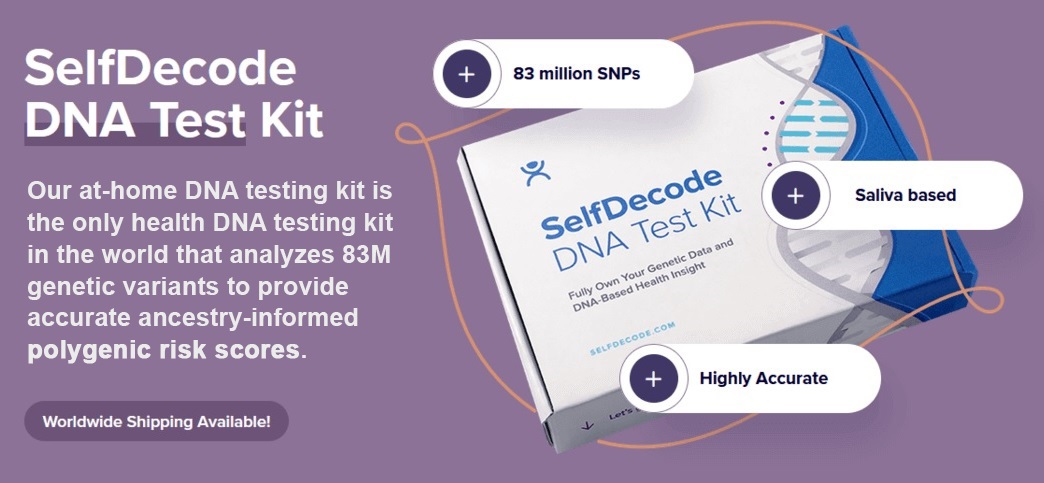
Readers wanting a fuller, more complete report, especially useful when trying to build a clearer personal health picture during a period of family uncertainty, might consider the SelfDecode At-Home DNA Test Kit, priced around $99, which processes a new sample from scratch rather than relying on a previously uploaded file.
Whatever the source of the data, a genetic finding during a moment like this is best treated as one piece of a much larger picture, one that includes medical guidance, time, and often support from people who understand exactly what this kind of discovery feels like.
Frequently Asked Questions
What does “NPE” mean in DNA testing?
NPE stands for “not parent expected.” It refers to situations where DNA test results reveal that a person’s biological parent isn’t who they believed, often surfacing an unexpected close genetic match instead.
Does a new biological relative mean I’ll inherit their health conditions?
Not automatically. Sharing DNA confirms a genetic relationship, but many health conditions depend on multiple genes and environmental factors, not simply on ancestry from one relative or family branch.
Should I talk to a professional after an unexpected parentage discovery?
Many people find it helpful to speak with a genetic counselor for health-related questions and a therapist experienced in identity or family-of-origin issues for the emotional side of the experience.
How common are unexpected parentage discoveries through DNA testing?
They’ve become more frequent as consumer DNA databases have grown into the tens of millions of users, since even a distant relative’s test can eventually surface a closer, unexpected match.
What should I do with new family health information after a parentage discovery?
It’s generally best to bring any new health information to a physician as background for future screening conversations, rather than treating it as an urgent medical finding on its own.