
If you’ve taken a 23andMe test, you probably remember the moment your results came in. Maybe you learned you’re part Ashkenazi Jewish, or found a third cousin you’d never heard of, or discovered your ancestors likely came from a region you didn’t expect. It’s a genuinely exciting experience, and for most people, that’s where the story ends. The results page closes the loop, and the raw file underneath gets forgotten in a settings menu somewhere.
That raw file, though, is worth a second look. It holds far more genetic information than what appears in your ancestry composition report, including data connected to health traits that 23andMe’s ancestry-focused reporting never touches. This article covers what’s actually stored in that file, why 23andMe doesn’t show you all of it, and how you can explore the health side of your own DNA.
What Sits Inside Your 23andMe Raw Data
When you spit into that 23andMe tube, a lab reads a huge number of specific spots along your chromosomes called SNPs. Each SNP marks a small variation in your genetic sequence, and it’s these variations that scientists use to study everything from eye color to disease risk to how your body handles certain medications. 23andMe reads roughly 600,000 to 700,000 of these SNPs per test, but your ancestry composition report only draws on a portion of them.
Why Your File Is Bigger Than Your Report
The company built its own separate health reports for paying members, covering things like carrier status for certain inherited conditions and genetic weight and wellness traits. Even with that, though, the raw data file you can download from your account contains the complete set of SNP readings, far more than what shows up in any single report, whether ancestry or health. It’s your genetic information, generated from your sample, and 23andMe makes it available to you directly.
Why Ancestry Reports and Health Genetics Are Built Differently
Ancestry composition estimates work by comparing your SNPs to reference populations from around the world. Health-related genetic analysis works completely differently. It relies on studies linking specific SNPs, or combinations of them, to traits like inflammation tendencies, sleep quality, or how efficiently your body processes caffeine and alcohol. These two types of analysis pull from overlapping raw data but interpret it in entirely separate ways, using separate bodies of scientific research.
That’s part of why no single ancestry-focused report can give you the full health picture. It’s not that the information isn’t in your file. It’s that ancestry composition tools were never built to interpret it that way. Your raw file is essentially neutral ground, a full set of genetic data waiting for whichever type of analysis you point at it.
The Genetic Traits That Never Made It to Your Ancestry Dashboard
Researchers have connected specific SNPs in your file to a long list of traits that have nothing to do with where your ancestors lived. Some examples include genetic patterns tied to caffeine metabolism, alcohol sensitivity, sleep duration, mood regulation, and inflammatory response. None of these show up in your ancestry composition percentages because they’re calculated from a different set of markers entirely, studied by a different branch of genetic research.
If you’ve ever wondered why you can drink coffee at 9 p.m. and still fall asleep easily while a family member can’t touch caffeine after noon, that difference likely traces back to specific genetic variants, the same kind sitting quietly in your 23andMe file right now. The same goes for other everyday differences between relatives, like why one sibling seems to get winded on a run while another barely notices the effort, or why certain foods sit fine with one family member and cause discomfort in another. These patterns often have genetic roots that show up in raw DNA data long before anyone thinks to look for them.
Getting a Second Read on Your 23andMe File
SelfDecode is a platform built specifically to interpret the health-related side of raw DNA data, and it accepts uploads directly from 23andMe, along with AncestryDNA, MyHeritage, FamilyTreeDNA, and several other testing services. Rather than taking a new test, you download your existing 23andMe raw file and upload it to a SelfDecode account, where it’s analyzed for genetic patterns linked to health and lifestyle traits, separate from anything related to ancestry.
It’s fair to mention a limitation here. An uploaded 23andMe file gives you a useful preview of your health genetics, but that preview is more limited than what SelfDecode produces from its own dedicated DNA kit. Third-party files like the one from 23andMe cover a smaller share of the genome, and they haven’t gone through SelfDecode’s in-house lab processing and validation steps, so the results are less complete and less precise than what the kit provides.
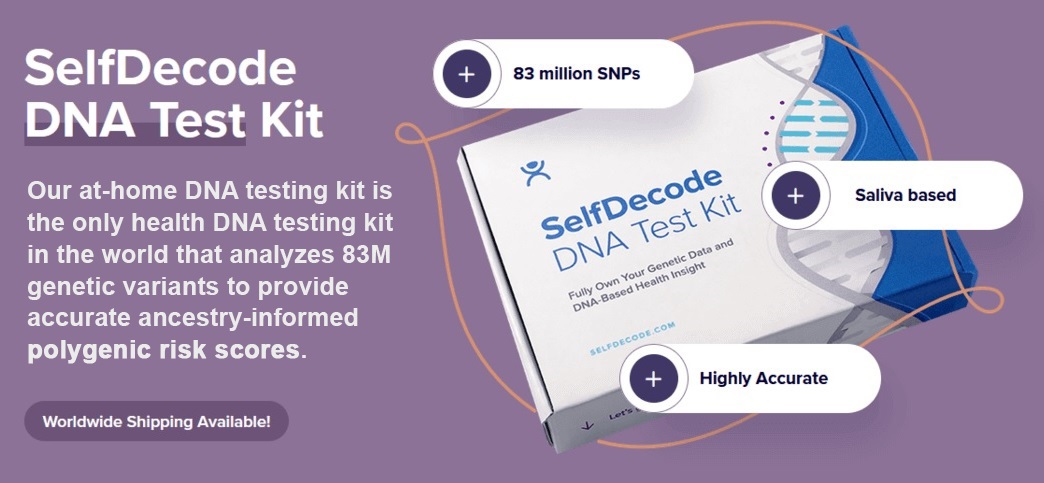
If your uploaded results leave you wanting more detail, ordering the SelfDecode At-Home DNA Test Kit is a logical next step. The kit reads far more of your genome and gives you access to SelfDecode’s full range of detailed health reports, offering a more complete and validated picture than an uploaded file alone can provide.
Your 23andMe file has already done its job for your family tree. Whether you explore the rest of it through an upload or a dedicated kit, there’s a whole side of your genetics that ancestry composition reports were never designed to show you.
Frequently Asked Questions
Can I download my raw DNA file from 23andMe?
Yes. 23andMe allows you to request and download your raw DNA data file from your account settings, and the file is sent to you securely once the request is processed.
Is my raw DNA file different from my ancestry composition report?
Yes. Your ancestry composition report is a processed summary based on comparing a portion of your SNPs to global reference populations. The raw file contains the full set of SNP readings from your test, most of which never appear in that report.
Can I use my 23andMe file on a health-focused platform like SelfDecode?
Yes. SelfDecode accepts raw DNA files from 23andMe and several other testing services, allowing you to get health-related genetic insights without taking a new test.
Does an uploaded 23andMe file give the same detail as SelfDecode’s own kit?
Not quite. Uploaded files provide a limited preview, since they cover less of the genome and haven’t gone through SelfDecode’s in-house lab processing and validation. Their own kit provides more complete and more precise results.
Do I need a new DNA test to look into my health genetics?
Not necessarily. You can start with the raw file you already have from 23andMe. For a more thorough and validated analysis, ordering a dedicated health-focused DNA kit is the more complete option.