
For most people, the DNA testing journey starts and ends in the same place: an ethnicity breakdown and a list of newly discovered cousins. That’s a satisfying destination on its own, and plenty of people are perfectly content stopping there. But for anyone curious about what else that same test revealed, there’s a clear, manageable path from “I know I’m partly Scandinavian” to “I understand something real about my own biology,” using data that’s often already sitting untouched in an old account.
This guide walks through that path step by step, aimed at someone who has never thought about their raw DNA data as anything beyond an ancestry tool. None of it requires scientific background or technical skill, just a willingness to look a little further into a file most people never open.
Step One: Understanding What Ethnicity Percentages Actually Come From
An ethnicity estimate is built by comparing a person’s DNA against reference populations with well-documented regional ancestry, identifying which patterns in that DNA most closely match which regions. This process uses a specific subset of the genetic markers collected during testing. It’s a useful and genuinely interesting piece of information, but it represents only one interpretation of the full dataset generated by the test, not the entirety of what that data contains.
It’s worth sitting with that distinction for a moment, since it’s easy to assume a DNA test measures a fixed, singular thing. In reality, the same underlying sample gets processed into a chip reading of several hundred thousand genetic markers, and the ethnicity report is simply one particular analysis run against a portion of that reading. Everything covered in the rest of this guide draws from that same original chip reading, just interpreted through a different lens.
Step Two: Locating and Downloading the Raw DNA File
Every major testing company, including AncestryDNA, 23andMe, MyHeritage, and FamilyTreeDNA, allows users to download their complete raw DNA file, typically through account or DNA settings. This file is a simple text document containing the full list of genetic markers read during testing, not just the portion used for the ethnicity report. Downloading it usually takes just a few minutes and doesn’t require any special software.
Step Three: Recognizing What Else Is Actually in That File
Once downloaded, it’s worth understanding that this file includes genetic markers connected to far more than ancestry: caffeine metabolism, taste perception, sleep patterns, inflammation tendencies, and many other health-related pathways are all represented in the same data used to generate an ethnicity percentage. None of this shows up in a standard ancestry report, not because it isn’t present, but because ancestry platforms are built to interpret only the ancestry-relevant portion of the file.
Step Four: Choosing a Health Platform and Uploading the Data
This is the point where the same raw file can be redirected toward a completely different kind of insight. SelfDecode, a genetics and health analysis platform, accepts uploaded raw DNA files from AncestryDNA, 23andMe, MyHeritage, and FamilyTreeDNA, and translates the health-related markers already present in that data into organized, readable reports covering topics like inflammation and autoimmunity, weight and metabolism, and serotonin and melatonin-related pathways connected to mood and sleep. The upload process itself is straightforward, generally involving downloading the file in step two and uploading it directly through SelfDecode’s platform.
Step Five: Understanding the Difference Between a Preview and a Full Analysis
It’s important to go into this step with accurate expectations. An uploaded third-party file provides a limited preview of SelfDecode’s full analysis. Because the file was originally generated using a different company’s lab and chip technology, it may not include every marker SelfDecode’s system is designed to read, and the resulting reports are narrower in depth than what comes from a sample processed directly through SelfDecode’s own lab, from collection through analysis.
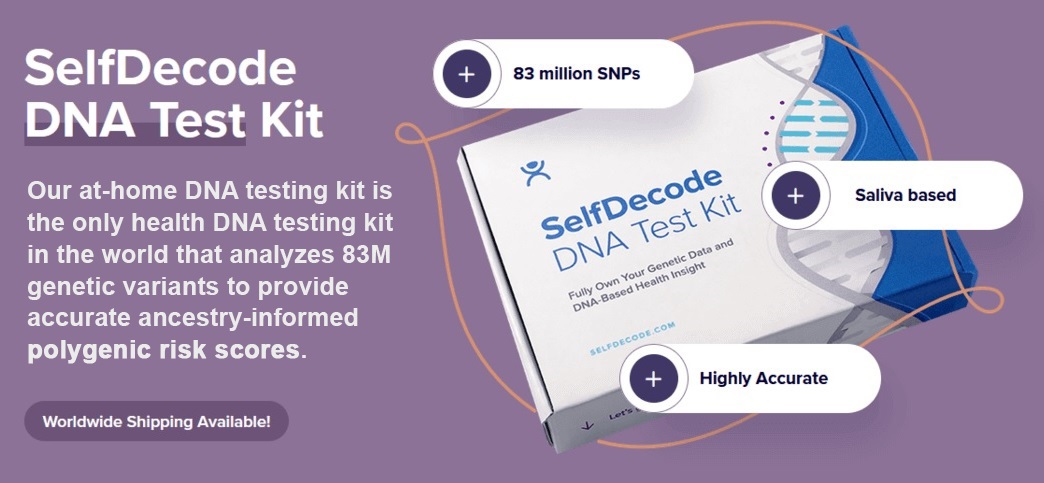
For anyone who wants the complete version of this picture, including a fuller panel of health reports and greater confidence in the underlying data, the SelfDecode At-Home DNA Test Kit, priced at approximately $99, processes a new sample directly through SelfDecode’s own lab, offering a more thorough alternative to working from an uploaded ancestry file alone.
Putting the Whole Path Together
Laid out end to end, the journey from ethnicity curiosity to personal health genetics is shorter than it might seem: understand what the ancestry report actually drew from, download the full file behind it, recognize what else that file contains, upload it somewhere built to read the health side of the data, and decide from there whether a fuller, dedicated test is worth pursuing. Each step builds naturally on the last, and none of them require starting over from scratch.
The curiosity that leads someone to spit in a tube for an ethnicity estimate and a handful of new cousins doesn’t have to stop there. The same sample, and the same file, has more to say, and reaching that second layer of information turns out to be a much shorter walk than most people realize.
Frequently Asked Questions
Do I need a new DNA test to explore health genetics?
Not necessarily. An existing raw DNA file from an ancestry test can be uploaded to a platform like SelfDecode for an initial health-related preview, without needing to submit a new sample right away.
Where do I find my raw DNA file?
Most major testing companies, including AncestryDNA, 23andMe, MyHeritage, and FamilyTreeDNA, offer a raw data download option within account or DNA settings, typically available within a few minutes of requesting it.
What’s the difference between an uploaded file and a new health test?
An uploaded file offers a limited preview, since it was generated by a different company’s lab and may not include every marker a health platform analyzes. A new test processed through that platform’s own lab offers a more complete result.
Is my ethnicity report based on all of my DNA data?
No. Ethnicity estimates use a specific subset of the genetic markers collected during testing. The full raw file includes considerably more information, including markers related to various health topics.
Is this process complicated for someone with no genetics background?
No. Downloading a raw DNA file and uploading it to a health platform typically involves just a few straightforward steps through account settings, without requiring any scientific or technical expertise.