Anyone who has already taken an AncestryDNA test and then come across SelfDecode online has probably had a reasonable moment of confusion. Aren’t these both DNA companies? Don’t they analyze the same spit sample? The short answer is that they use very similar underlying technology but built entirely different products on top of it, aimed at answering completely different questions.
AncestryDNA exists to answer questions about family history: where ancestors came from, who a person is related to, and how a family tree connects across generations. SelfDecode exists to answer questions about personal health: how the body processes nutrients, what inflammation tendencies look like, and how various genetic pathways relate to weight, mood, and metabolism. Understanding exactly where these two tools diverge, and where they can actually work together, makes it much easier to get full value out of DNA data that’s often only used for half of what it’s capable of.
What AncestryDNA Actually Measures and Reports
AncestryDNA analyzes a saliva sample using a genotyping chip that reads several hundred thousand specific points across the genome, known as SNPs. From that data, AncestryDNA generates an ethnicity estimate, breaking down a person’s genetic background into regional percentages, and compares a user’s DNA against its database to identify likely relatives, from close family members to distant cousins. Some ethnicity and relative-matching results also feed into features like historical record hints and family tree suggestions.
AncestryDNA’s core product is built entirely around genealogy. It does not provide meaningful health-related analysis, and while it reads a broad panel of genetic markers to generate its results, the platform itself only interprets and reports on the portion of that data relevant to ancestry and relative matching. Users can download their full raw data file directly from their AncestryDNA account settings, which is worth knowing since that download includes far more genetic information than the ethnicity percentages and match list displayed in the app itself.
What SelfDecode Actually Measures and Reports
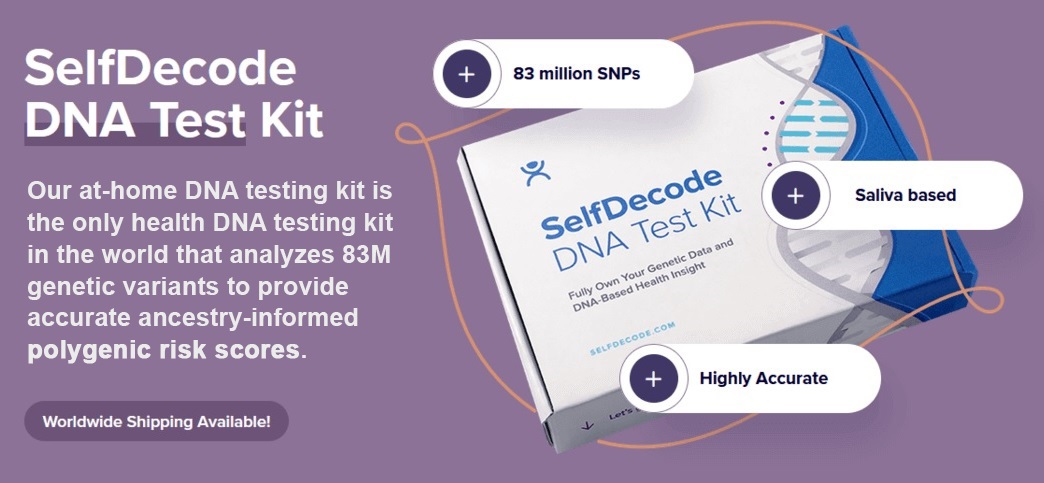
SelfDecode, a genetics and health analysis platform, is built around a different goal entirely: translating genetic data into personalized health information. Its core product is an at-home DNA test kit that, once processed through SelfDecode’s own lab, generates a large library of individual reports covering topics such as inflammation and autoimmunity tendencies, weight and metabolic pathways, and serotonin and melatonin-related patterns connected to mood and sleep. SelfDecode offers over a thousand individual reports across various health-related genetic pathways.
SelfDecode does not provide ancestry estimates, ethnicity breakdowns, or relative matching. Its entire product is oriented around health, not genealogy, which is essentially the mirror image of what AncestryDNA offers.
Where the Two Overlap, and Where They Don’t
Both companies read a broad set of genetic markers from a DNA sample, and there’s real overlap in the underlying raw data collected during testing. Where they diverge sharply is in interpretation. AncestryDNA reports on the ancestry-related subset of that data. SelfDecode reports on the health-related subset. Neither company’s core product covers what the other specializes in, even though the raw genetic material collected during testing often includes information relevant to both.
Comparing the Two Side by Side
| Category | AncestryDNA | SelfDecode |
|---|---|---|
| Primary focus | Ancestry and family history | Health and genetics |
| Core reports | Ethnicity estimate, relative matching | 1,000+ health-related genetic reports |
| Example topics | Regional origins, cousin matches, family trees | Inflammation, weight, mood, sleep pathways |
| Accepts uploaded raw DNA files | Limited relative-matching options for uploads | Yes, for a preliminary health preview |
| Best for | Building a family tree, finding relatives | Understanding personal health genetics |
This kind of side-by-side comparison makes the distinction fairly clear: choosing between the two isn’t really the right framing, since they aren’t competing for the same purpose. The more useful question is how to get value from both, especially for someone who has already tested with one of them.
Can You Use Both? How the Two Platforms Work Together
For anyone who has already taken an AncestryDNA test, the raw DNA file downloaded from an AncestryDNA account can be uploaded directly to SelfDecode. This gives a first look at the health-related genetic information already sitting in that data, without needing to submit an entirely new sample. It’s a practical way to get value out of testing that was originally done purely for genealogy purposes.
It’s worth being clear that an uploaded AncestryDNA file only provides a limited preview through SelfDecode. Because the file was generated using AncestryDNA’s own lab and chip technology rather than SelfDecode’s, it may not include every marker SelfDecode’s system is built to analyze, and the resulting reports are narrower than what a sample processed directly through SelfDecode’s own lab would produce.
For a more complete health analysis, the SelfDecode At-Home DNA Test Kit, priced at approximately $99, processes a new sample from scratch through SelfDecode’s own lab, offering the fuller version of the reports that an uploaded AncestryDNA file can only partially provide. This approach works well for someone who wants to keep their existing AncestryDNA account fully intact for ongoing genealogy research, family tree building, and new cousin matches, while still getting a more complete, independently validated look at the health side of their genetics through a separate, dedicated test.
AncestryDNA and SelfDecode were built to answer entirely different questions, and for someone who has already invested in one, the other doesn’t require starting over. It simply extends the same curiosity about DNA in a different, equally personal direction.
Frequently Asked Questions
Is SelfDecode the same kind of company as AncestryDNA?
No. AncestryDNA focuses on genealogy, including ethnicity estimates and relative matching. SelfDecode focuses on health, offering genetic reports on topics like inflammation, metabolism, and mood.
Can I upload my AncestryDNA raw data to SelfDecode?
Yes. SelfDecode allows users to upload an existing raw DNA file from AncestryDNA to get a limited preview of health-related genetic information, without needing a new test.
Does AncestryDNA offer any health reports?
AncestryDNA’s core product is built around genealogy and does not provide meaningful health-related genetic analysis, even though the underlying raw data it collects includes markers relevant to health.
Do I need to take a new DNA test to use SelfDecode?
Not necessarily. An existing raw DNA file from AncestryDNA can be uploaded for a limited preview. For a more complete analysis, SelfDecode’s own at-home test kit processes a new sample directly through its own lab.
Which one should I use, AncestryDNA or SelfDecode?
They serve different purposes rather than competing directly. AncestryDNA is suited for family history and relative matching, while SelfDecode is suited for personal health genetics, and many people find value in using both.