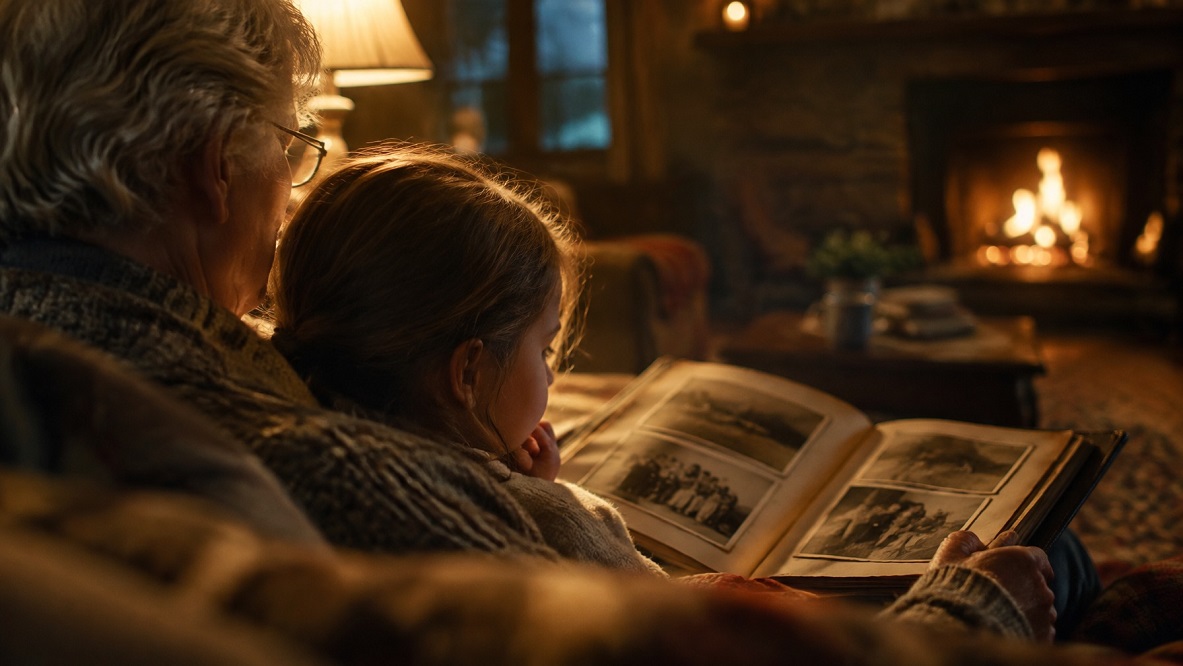
To become the family storyteller, pick short stories about real people, tell them where your family already gathers, and write down the ones people ask for again. Start small, with one ancestor and one moment, and share it in your own voice. Stories passed along this way give younger relatives a living link to the family’s past.
Start With Stories That Fit in a Minute
Long family sagas lose listeners. A one-minute story about one person and one moment holds attention and is easy to repeat. Maybe an ancestor crossed an ocean with a single trunk. Tell that moment: the trunk, the weather, the first meal in a new town.
Build each story around a person, a place, and one detail your listener can picture. Leave out the long list of siblings and the full chain of dates. You can share those later, once your listener is curious. A short story is an invitation, and the listener will often ask for the next one.
Practice on a patient listener first. Tell the story to a spouse or a friend, notice where their attention drifts, and trim the parts that drag. Two or three tellings will smooth the rough spots, and you will start to hear which details people repeat back to you.
Use Objects and Photos as Story Starters
Objects give a story something to hold. Gather a few items that carry a family connection and keep them where you can reach them during a visit:
- A recipe card in a relative’s handwriting.
- A medal, pin, or button from a uniform.
- A photo of a house or a street that has changed.
- A letter or postcard with a postmark.
Pass the object to a listener and ask who they think owned it. Let them guess before you tell the story. Guessing pulls listeners in, and it gives you a natural way to begin.

Tell Stories Where Your Family Already Gathers
You do not need a special event. The Library of Congress observes that a holiday dinner table lets relatives of several generations share and compare experiences, and that different branches of a family sometimes know different versions of the same story.
Use that. Between the main course and dessert, tell one short story and ask whether anyone remembers it differently. Write down the added details afterward. Your story becomes a shared one, and every relative who adds a piece has a reason to help you keep it going.
Show Young Listeners That History Comes From People
A Library of Congress junior fellow created a family oral history activity with interview tips and sample questions for parents and grandparents, such as how children were named and what songs the family sang. The post hopes children will see that history comes from people, not only books.
Invite the children in your family to ask those questions themselves. Give each child two or three questions and a phone or recorder. Children often ask the questions adults forget, and a grandparent may answer a grandchild in a way they would not answer you.
Write Down the Stories People Ask For Again
The stories your family requests again and again are the ones to save first. The Library of Congress suggests in a post on writing your family history that turning names and dates into a narrative helps ancestors come across as real people.
Keep one page per story, with the storyteller’s name, the date, and a line about where the story came from. Add the best detail you can verify. Over a year, a handful of single pages becomes a small collection you can print, share by email, or read aloud at the next gathering.
Tell One Story at Your Next Gathering
Pick one short story about one ancestor, and tell it out loud at your next family meal. Bring one object or photo to help. Afterward, ask a single question: what does anyone remember about this person? Write down every answer.
Frequently Asked Questions
How Can a Shy Person Start Telling Family Stories?
Begin with one listener, such as a cousin or a child, and share a single short story. Use a photo to guide you so you do not have to remember everything. Ease comes with practice.
What Makes a Family Story Worth Telling?
A good story has a person, a moment, and a detail that makes it vivid, like a place or an object. It does not need to be dramatic. Ordinary days make good stories too.
How Do I Keep Family Stories Accurate?
Tell the story as it was told to you, and say who told it. Check key facts against records when you can. If versions differ, share both.
How Can I Involve Children in Family Stories?
Ask them to interview a grandparent with three simple questions. Let them hold an object or photo while they listen. Save their questions too, since they become part of the story.