

A consumer DNA test can feel comprehensive. It produces an ethnicity breakdown, a list of relatives, and sometimes a handful of trait or health reports, all from a small tube of saliva. It’s easy to assume this means the entire genome has been read and analyzed. In reality, standard consumer DNA tests examine a relatively small fraction of a person’s total genetic code, and understanding why reveals a lot about both the strengths and the real limitations of this kind of testing.
This isn’t a flaw specific to any one company. It’s a shared technical reality across the entire consumer DNA testing industry, rooted in the type of technology used and the tradeoffs that come with it. Knowing what’s actually being measured, and what isn’t, makes it much easier to interpret any DNA report with the right amount of context.
SNP Genotyping vs. Whole Genome Sequencing: The Core Technical Difference
The human genome contains roughly three billion base pairs, the individual chemical letters that make up DNA. Fully sequencing all three billion of them, a process called whole genome sequencing, is technically possible but remains considerably more expensive and time-intensive than the technology most consumer DNA companies use. Instead, nearly every major consumer DNA testing company relies on a technology called SNP genotyping, which reads a curated set of somewhere between 600,000 and 700,000 specific, predetermined locations across the genome, known as single nucleotide polymorphisms, or SNPs.
These specific locations were chosen because they’re known to vary meaningfully between individuals and populations, making them useful for ancestry estimation, relative matching, and identifying certain well-documented genetic markers. But this approach, by design, only looks at a tiny fraction of the total genome, roughly 0.02 percent of all base pairs, leaving the vast majority of a person’s DNA completely unexamined by a standard consumer test.
What Falls Outside a Standard SNP Panel
Because SNP genotyping only reads predetermined locations, it misses several categories of genetic variation entirely. Structural variants, including insertions, deletions, and duplications of larger stretches of DNA, generally fall outside what a genotyping chip can detect. Copy number variants, where a person has an unusual number of copies of a particular gene, are similarly missed in most cases. Even within the regions a chip does examine, extremely rare variants that haven’t been included in the chip’s predetermined list simply won’t be captured, regardless of how relevant they might be to that specific person’s health or ancestry.
Why Ancestry Companies Don’t Test for More
The decision to use SNP genotyping rather than whole genome sequencing comes down to a combination of cost, speed, and practical sufficiency. Genotyping chips are dramatically cheaper to run at scale than full sequencing, which is part of why consumer DNA tests can be priced affordably enough for tens of millions of people to have taken them. For the specific purposes these companies are built around, primarily ethnicity estimation and relative matching, a well-chosen panel of several hundred thousand SNPs provides more than enough information to generate accurate, useful results, without the added cost and complexity of full sequencing.
Health-focused genetics platforms, including SelfDecode, generally use this same genotyping approach as well, for similar reasons of cost and scale. The meaningful difference between an ancestry-focused platform and a health-focused one isn’t usually the underlying chip technology, it’s which portion of that same SNP data actually gets interpreted and reported back to the user.
Rare Variants and the Gaps They Leave Behind
One of the more important practical implications of this technology gap involves rare genetic variants, which are often the most clinically significant ones in medical genetics. Many well-known disease-causing mutations are individually rare, and if a specific rare variant isn’t included on a testing company’s chip, it simply won’t show up in that person’s results, even if it’s present in their DNA. This is part of why a “negative” consumer DNA result for a particular condition doesn’t rule out an underlying genetic risk with full certainty. It only means the specific variants that chip was built to detect weren’t found, which is a narrower statement than it might initially sound.
What This Means for Interpreting Any Consumer DNA Report
None of this makes consumer DNA testing unreliable for the purposes it’s actually designed for. Ethnicity estimates, relative matching, and reports built around well-documented, common genetic variants remain solidly grounded in real science. The key is understanding the boundaries of what any given report can and can’t say. A consumer DNA test offers a detailed look at a specific, well-chosen slice of the genome, not a complete genetic biography, and treating it that way leads to a much more accurate understanding of what any result actually means.
Getting More From the Same Raw DNA File
Because the SNP data collected by ancestry companies overlaps significantly with the SNP data used by health-focused platforms, the raw DNA file downloaded from AncestryDNA, 23andMe, MyHeritage, or FamilyTreeDNA can be uploaded to SelfDecode, a genetics and health analysis platform, to generate reports covering areas like inflammation, metabolism, and mood-related pathways using data already collected during a standard ancestry test.
It’s worth noting that an uploaded file only provides a limited preview of this analysis. Because the file was originally generated using a different company’s specific chip and lab process, it may not include every marker SelfDecode’s own system is built to analyze, and the resulting report is narrower than what a sample processed directly through SelfDecode’s own lab would provide.
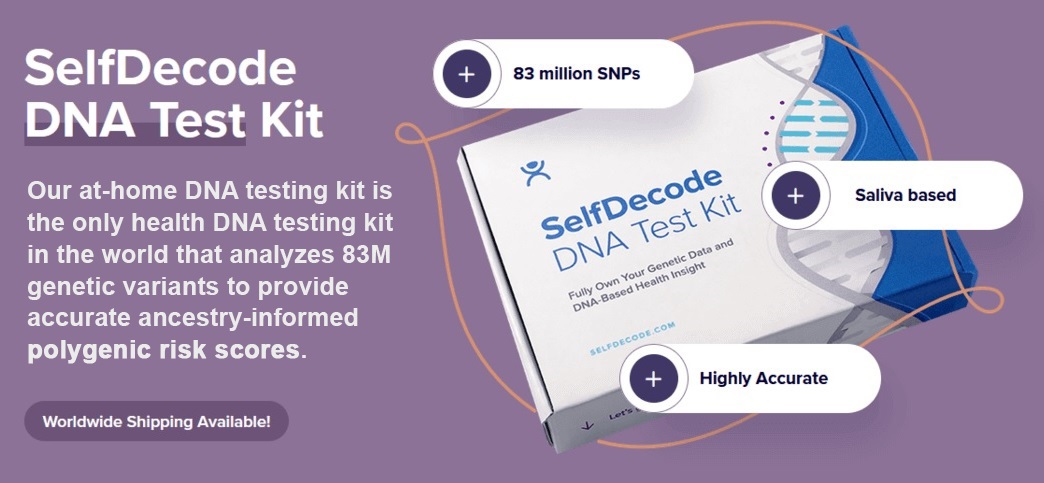
For a fuller picture, including SelfDecode’s more complete panel of reports, the SelfDecode At-Home DNA Test Kit, priced at approximately $99, processes a new sample through SelfDecode’s own lab and chip from the start.
Every consumer DNA test, regardless of which company runs it, is built on the same fundamental tradeoff between depth and practicality. Understanding that tradeoff turns any genetic report, ancestry or health, into something read with appropriately calibrated expectations rather than treated as a complete genetic picture.
Frequently Asked Questions
Do consumer DNA tests sequence my entire genome?
No. Most consumer DNA companies use SNP genotyping, which reads a predetermined set of roughly 600,000 to 700,000 specific locations across the genome, a small fraction of the three billion base pairs that make up the full genome.
Why don’t ancestry companies use whole genome sequencing instead?
Whole genome sequencing is considerably more expensive and time-intensive. SNP genotyping is far cheaper to run at scale and provides sufficient information for ancestry estimation and relative matching, which are the primary purposes these companies are built around.
What kinds of genetic variation do consumer DNA tests miss?
Standard tests generally miss structural variants like insertions and deletions, copy number variants, and any rare variants not included in the testing chip’s predetermined list of locations.
Does a negative result on a consumer DNA test rule out a genetic condition?
Not necessarily. A negative result only means the specific variants that particular test was built to detect weren’t found. It doesn’t rule out rare variants outside that chip’s scope.
Do health-focused DNA platforms use different technology than ancestry companies?
Generally, no. Most health-focused platforms, including SelfDecode, use similar SNP genotyping technology. The main difference is which portion of the resulting data gets analyzed and reported to the user.