

Long before written history, before nations had borders, and long before anyone kept records of who traveled where, human populations were already on the move. Groups migrated across continents in search of food, favorable climates, and safety, gradually settling new regions over tens of thousands of years. Every one of those journeys left a trace, not in a document or an artifact, but in the DNA carried forward by every generation that followed.
This is a different kind of history than what most genealogists are used to researching. It’s not measured in decades or centuries, but in tens of thousands of years, and it’s recorded not in archives but in your own genetic code. This article looks at how scientists trace ancient migration through DNA, what the broad story of human migration actually looks like, and how that deep history connects to the genetics you carry today, well beyond the more recent family history most genealogy research focuses on.
The Genetic Markers Scientists Use to Trace Ancient Migration
Researchers trace ancient migration using specific types of genetic markers, particularly those found in mitochondrial DNA, passed down almost unchanged from mother to child, and Y-chromosome DNA, passed down from father to son. Because these types of DNA change very slowly over time through small mutations, scientists can group people into broad genetic categories called haplogroups, each associated with a particular ancestral migration path. Comparing haplogroups across populations around the world has allowed researchers to reconstruct, in broad strokes, how humanity spread across the globe.
Why These Markers Work So Well for Deep History
Unlike most of your DNA, which is a blend of genetic material from both parents recombined in each generation, mitochondrial and Y-chromosome DNA are passed down in a much more direct line. That makes them especially useful for tracing ancestry back thousands of years, since the mutations that accumulate in this DNA over time create a kind of genetic timestamp, allowing researchers to estimate roughly when and where specific migration branches split apart.
The Broad Strokes of Human Migration History
Genetic and archaeological research generally supports the idea that modern humans originated in Africa and began migrating outward tens of thousands of years ago, eventually reaching every inhabited continent. From there, distinct migration waves spread into the Middle East, across Asia, into Europe, and eventually across land bridges and by sea into the Americas and the Pacific Islands. Each of these migrations happened over thousands of years, with populations splitting, settling, and sometimes migrating again as conditions changed.
These migration patterns are the deep-history foundation beneath your ethnicity report. The regional percentages you see in a standard ancestry test are a much more recent snapshot, but the underlying genetic markers that made those percentages possible trace back to this much older story of global human movement.
What Ancestry Reports Show About Migration, and What They Leave Out
Many DNA testing companies include some version of a migration map alongside ethnicity results, showing rough paths your ancestors may have traveled based on genetic markers in your results. These maps are a genuinely interesting glimpse into deep ancestry, but they only tell part of the story. The same genetic markers used to trace migration exist alongside an entirely separate category of genetic information, one connected to health and lifestyle traits that migration and adaptation also shaped along the way.
Migration didn’t just move people to new places. It also exposed those populations to new climates, foods, and diseases, which is exactly the kind of pressure that shapes the health-related genetic traits discussed elsewhere on this site, from lactose tolerance to altitude adaptation. Migration history and health genetics are two sides of the same story, even though most ancestry reports only tell one half of it. Reading only the migration half is a bit like reading the setting of a story without ever finding out what happened to the characters who lived through it.
Connecting Your Migration History to Your Health Genetics
If you’ve already taken a DNA test for genealogy purposes, your raw DNA file contains far more than the markers used for your migration map or ethnicity percentages. Uploading that file to a health-focused platform like SelfDecode allows you to explore the health and lifestyle side of the same genetic story, connecting the migration your ancestors undertook to the traits their descendants, including you, ultimately inherited.
It’s worth knowing that an uploaded file provides a more limited preview than SelfDecode’s own dedicated DNA kit, since third-party files cover a smaller portion of the genome and haven’t gone through SelfDecode’s in-house lab processing and validation.
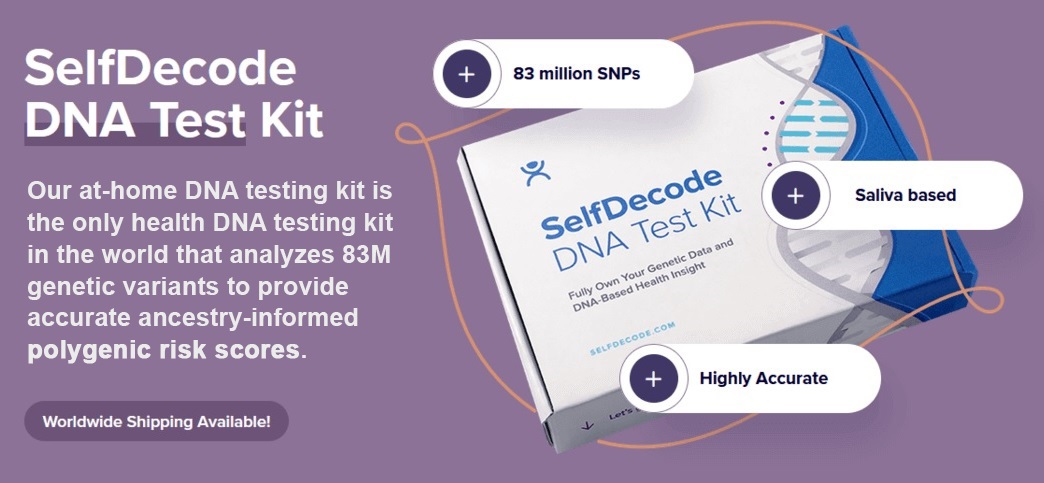
For a more complete and validated picture connecting your ancestral migration to your present-day genetics, the SelfDecode At-Home DNA Test Kit reads a much larger share of your genome and unlocks detailed reports across a wide range of health categories. It’s a way to read the rest of the story your migration map only hinted at.
Your ancestors’ journey across continents didn’t end when they finally settled. It’s still being written, quietly, in the genetic code passed down to you, carried forward through every generation between that original journey and the family you know today.
Frequently Asked Questions
How do scientists trace ancient human migration through DNA?
Researchers use mitochondrial DNA and Y-chromosome DNA, which are passed down in a direct line and change slowly over time, to group people into haplogroups associated with specific ancestral migration paths.
Where did modern human migration begin?
Genetic and archaeological research generally supports the idea that modern humans originated in Africa and began migrating outward tens of thousands of years ago, eventually reaching every inhabited continent.
Are migration maps in ancestry reports accurate?
They offer a genuinely useful glimpse into deep ancestry based on genetic markers, though they represent broad historical patterns rather than precise individual travel routes.
Yes. Migration exposed populations to new climates, foods, and diseases, which shaped many of the same genetic traits connected to health and lifestyle that a platform like SelfDecode can analyze.
Can I explore this using a DNA test I’ve already taken?
Yes. Raw DNA files from services like AncestryDNA or 23andMe can be uploaded to a health-focused platform such as SelfDecode to explore genetic markers beyond standard ancestry results.